Arrival and the Civil War
George was born Georg Wilhelm Ehrenfried Wesemann at the Thran mill, in the district of Eschershausen in the Duchy of Brunswick (Herzogtum Braunschweig), on 30 July 1838. His parents, his boyhood and his leaving are told in the Wesemann Family section. In January 1860 the state gave him leave to emigrate. Its file describes a journeyman miller living near Linse, without property and unable to do wage labor because of his chest, who was going to the house of an uncle “settled in America for years already and of means”. He left alone. Other young men of Halle parish had gone before him: the district’s emigration cards list Ludewig Brand, a shop assistant born in 1836, and Ludwig Wilhelm August Brünig, a journeyman miller born in 1835, both in 1854, and Wilhelm Brünig, born in 1838, in 1857. The Brünigs were one of the two milling households of Linse. No record connects any of them to George.
On 12 March 1860, seven weeks after his consent, George reached New York aboard the ship New York from Bremen and Southampton. The manifest describes him as a miller of 22, 5 feet 7 inches tall, fair-skinned, with dark eyes. He was the only Wesemann on board. In America he went by George, the first of his three forenames in its English form. Six years later his marriage entry in Philadelphia called him “Georg Wesemann aus Linse, Braunschweig” (Georg Wesemann from Linse, Brunswick), the very village the German file places him in. His American censuses give Brunswick as his birthplace and ages that fit the Thran birth date, and at his naturalization he renounced his allegiance to its ruler. Those records tie the Philadelphia grocer to the miller’s son of Thran.
Where George lived and how he earned his living in his first five years in America is not known. A family printout places him in Philadelphia by 1864. Who the uncle was, and where he lived, is not known either (see Wesemann Family). Nor is it known why George settled in Philadelphia; he was the only Wesemann in the city’s census of 1870.
In March 1865 George enlisted in New Jersey as a substitute, taking another man’s place for one year. He was enrolled on 27 March as a private in Company G of the 15th New Jersey Volunteer Infantry. The war was nearly over. Sherman’s army had marched from Atlanta to the sea and taken Savannah in December 1864. Five days after George enlisted, Grant’s army fought at Five Forks, on 1 April, and on 9 April Lee surrendered at Appomattox Court House. George had arrived for the last two weeks of the war. On 21 June 1865 he was transferred to Company G of the 2nd New Jersey Volunteer Infantry at Hall’s Hill, Virginia, and he was discharged there on 11 July 1865 on War Department orders, after three months and fourteen days of service.
His discharge certificate survives in the family, with its fold lines, a seal, foxing, and the printed oath of identity on the back. It is a printed Army form (A.G.O. No. 99) filled in by hand. It describes him as a private in 1st Lieut. James Van Antwerp’s Company G, 2nd Regiment of New Jersey Volunteers, born in Germany, 26 years old, 5 feet 7 inches tall, of light complexion with dark eyes and dark hair, a miller when he enrolled. The margin notes “Paid in full July 22, 1865.” The back carries the War Department telegram of June 1865 that ordered the regiment mustered out and the mustering officer’s note at Trenton dated 13 July 1865. In 2000 the certificate was believed to be with George’s grandson George Foster Wesemann.
George became a citizen as a soldier. On 27 September 1866 he swore the oath of citizenship in open court before the Supreme Court of Pennsylvania at Philadelphia. He did so as an honorably discharged private of Company G, 2nd New Jersey Volunteers, enlisted on 27 March 1865 and discharged on 11 July 1865, and he renounced his allegiance to the “Grand Duke” of “Braunsweick.” He signed “Geo. Wesemann,” and Mathias Fenendinger(?), a citizen, was his witness. His petition, no. 7658, was filed the next day. The printed form allowed an honorably discharged volunteer to be naturalized after one year in the country without a first declaration, so the oath was probably his final step, not a declaration of intent. The petitioner was probably this George: his name, Brunswick, Philadelphia, his regiment and both dates of his service all fit.
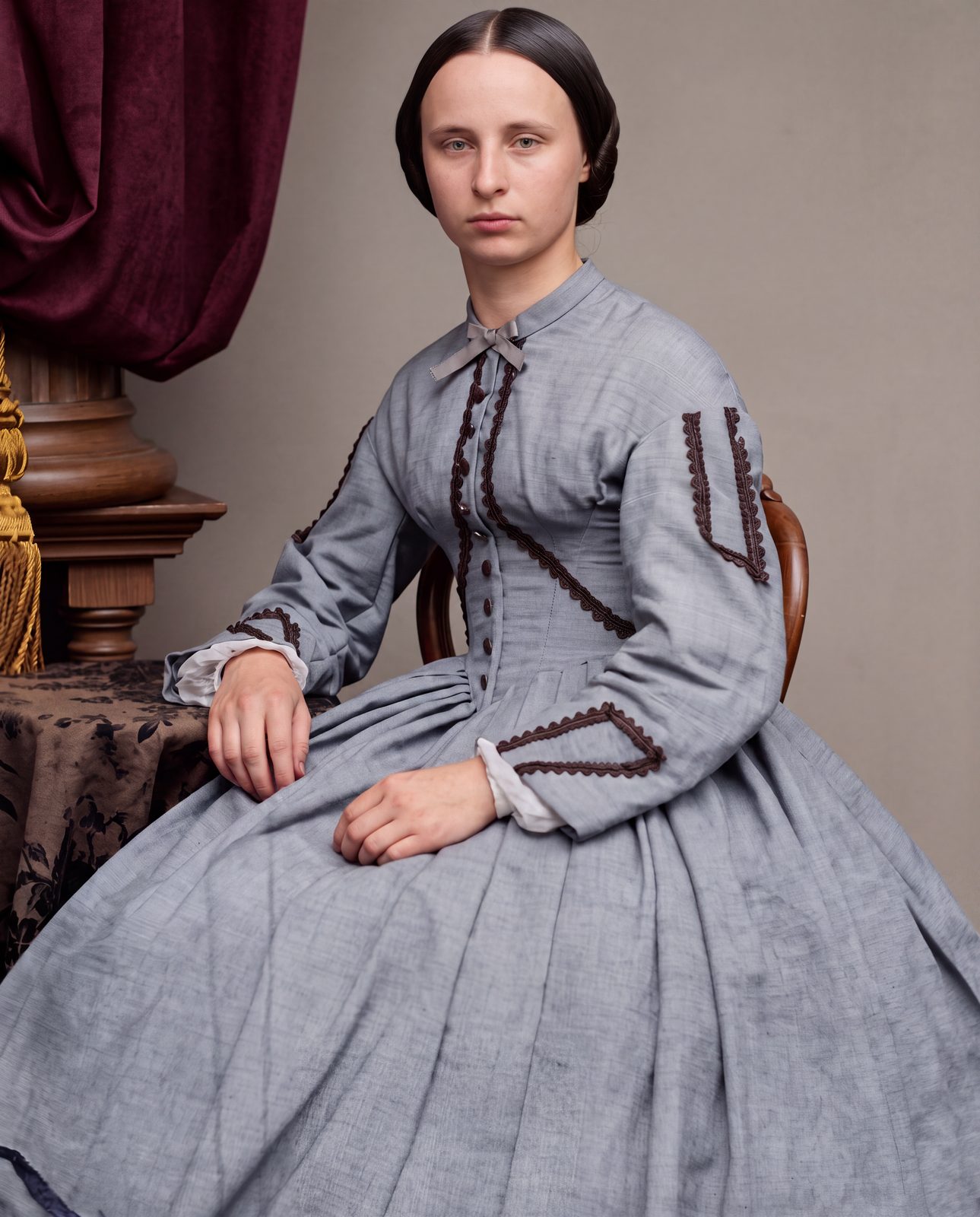
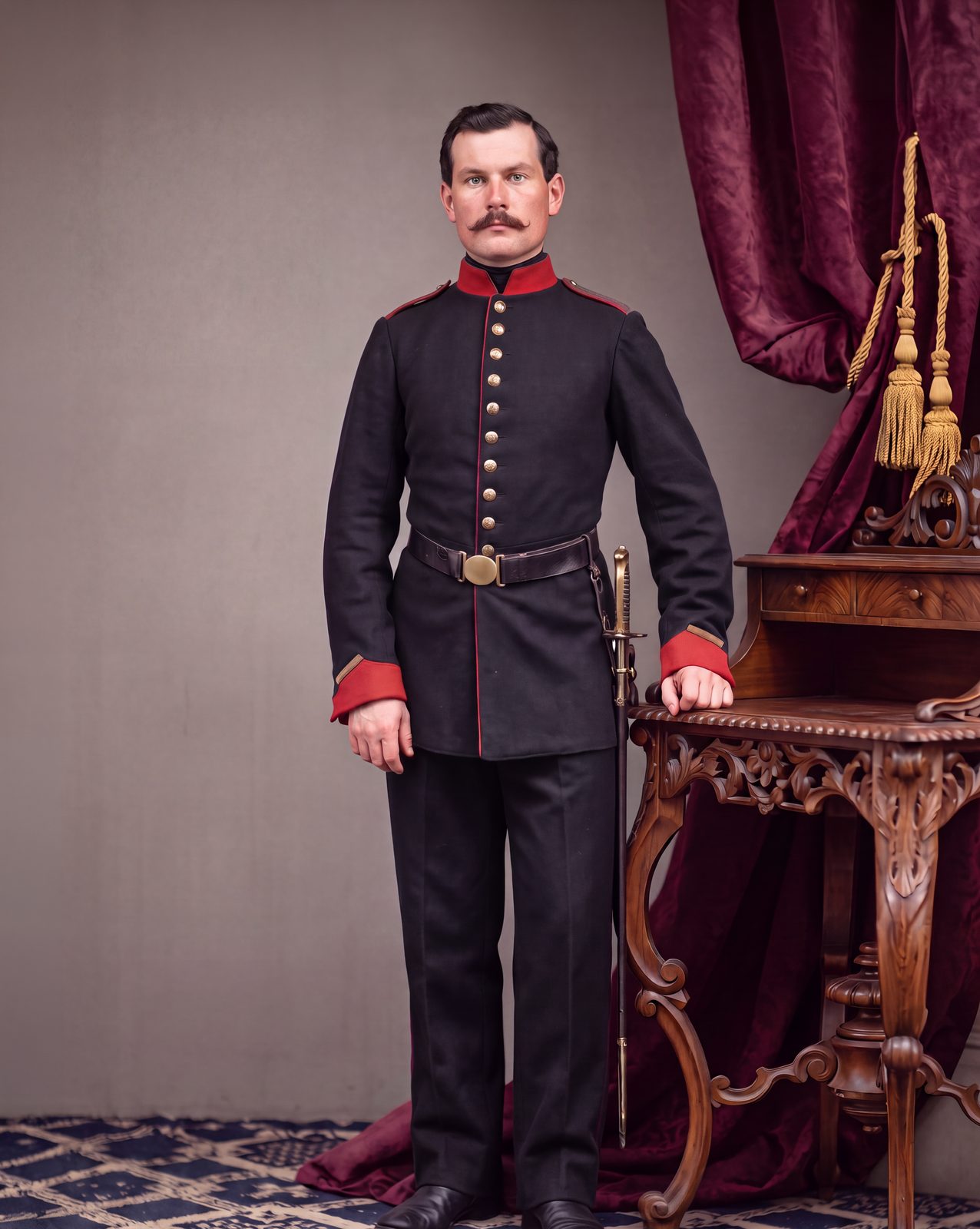
Two photographs, handed down in his daughter Sophia’s family and supplied by one of her grandsons, are the only known likenesses of the immigrant generation. One, of a seated woman, is inscribed “Sophia’s mother.” The other, of a man in uniform, is blank. Family tradition takes it to be George, and its caption says plainly that this is an assumption. Later photocopies of the pair are labeled “GEORGE WASHINGTON WESEMANN” and “FREDRIKA WESEMANN,” which puts the son’s name on the uniform portrait, so which George it shows is not settled. The Wesemann Family section describes the uniform.
References
- Niedersächsisches Landesarchiv, Arcinsys online emigration index (Amt Eschershausen), and the GOV historical gazetteer, consulted 16 August 2026.
- correspondence with Jürgen Diehl, Niedersächsisches Landesarchiv, including his answer on the 1850s muster rolls (NLA WO, 26 Neu 1, section 14). Herzogliche Kreis-Direction Holzminden to the Herzoglich Braunschweig-Lüneburgisches Staats-Ministerium, 24 January 1860, and the Ministry’s reply of 28 January. Read the record
- NLA WO, 273 N, Nr. 33, and NLA WO, 34 Z, Nr. 110, the compiled Braunschweig emigration card indexes. Cited here for Ludewig Brand, b. 1836, Handlungsdiener, 1854; Ludwig Wilhelm August Brünig, b. 1835, Müllergeselle, 1854 (34 Z Nr. 110 Bd. 1, Nr. 56); and Wilhelm Brünig, b. 1838, 1857.
- New York, Passenger Lists, 1820–1957 (Ancestry.com, Provo, Utah, 2010), Year 1860, Microfilm Serial M237, Roll M237_199; arrival of the ship New York, 12 March 1860.
- St. Michael’s and Zion marriage register entry, George Wesemann and Fredericka Bauer, 1866, family archive scan. Read the record
- 1870 U.S. Federal Census record, George Wesemann household, family archive scan. Read the record
- 1880 U.S. Federal Census record, George and Fredericka Wesemann household, family archive scan. Read the record
- Word-for-word transcriptions of the remainder of the scanned family archive, filed as individual documents across
- Supreme Court of Pennsylvania, Philadelphia, naturalization petition no. 7658, George Wesemann, filed 28 Sept. 1866, oath sworn 27 Sept. 1866 (Ancestry.com, “Pennsylvania, U.S., Naturalizations”). Read on the images.
- Ancestry.com LifeStory printout, George Wesemann (1838-1896) (paywalled; cited as record location), family archive scan.
- A family researcher, research notes on George Wesemann (b. 1839), June 2016, family archive scan.
- A family researcher, research notes on the Wesemann, Bauer, Knoll and Weiss lines, June 2016.
- Certificate of Discharge, George Wesemann, 1865, family archive scan. Read the record
- Fold3/NARA Civil War memorial printout, George Wesemann (Westman), memorial 656811377, family archive scan. Read the record Read the record
- A family researcher, “Geo. Wesemann in the Civil War,” reitter.net, last modified 26 December 2000.
- Fold3 / NARA, memorial for “George Westman” (alternate “George Wesman”), memorial 656811377, created 6 June 2021; Civil War service records, 15th and 2nd New Jersey Volunteer Infantry.
- Captioned family photographs, Wesemann family archive, pages 50-53, family archive scan.
- Photograph of an unidentified man in military uniform, family archive scan, with transcript description