George: Boyhood and Leaving
Boyhood
Georg Wilhelm Ehrenfried Wesemann was born at the Thran mill on 30 July 1838, at two in the afternoon, and baptized at Kemnade on 2 September(?) 1838. The entry names his father as “mill leaseholder at Thran” and his mother as “born Brand,” aged twenty-nine. His godparents were Marie Johanne Henriette(?) Wilhelmine Albrecht, born Müller; “Georg Alexander(?) Ludewig, master miller at Thran”; and Johann Ehrenfried Rödeling(?) of Kemnade, whose trade cannot be read. George’s third name, Ehrenfried, came from that godfather, as the family’s children so often took a godparent’s name.
The entry does not give his parents’ names, but the details fit only one couple. The tenant of the Thran mill was Heinrich Christian Ludewig Wesemann, the only member of the family ever recorded holding it, and a mother born Brand who was twenty-nine in the summer of 1838 fits Johanne Caroline Wilhelmine Brand, born on 16 July 1809. The birth date and hour agree with George’s emigration record and with his military file of 1860, made twenty-two years later by another office, and the entry is an ordinary numbered baptism. George’s parents were almost certainly Heinrich Christian Ludewig Wesemann and Johanne Caroline Wilhelmine Brand.
The second godfather is a puzzle. A man entered with three forenames and no surname would normally share the surname at the head of the column, so this may have been another Wesemann styled master miller (Mühlenmeister) at Thran, a title of an owner, where George’s father is always the lesser mill leaseholder (Mühlenpächter) in the Thran records. The reading is weak, and he was most likely George’s grandfather, Georg Ludewig, entered under Thran because that was where the household lived. That a second Wesemann miller lived at Thran in 1838 is a theory only, not proven, and unlikely. The household had not vanished from Linse in the year of George’s birth: a “machine-miller’s daughter,” his aunt Luise, stood godmother there in 1838.
George spent his early boyhood at Kirchbrak, where his father leased a mill from 1840, and the household was probably still there in 1847. By his early teens the family was back near Linse, landless. His mother died in March 1852, when he was thirteen.
Linse counted him as one of its own. Its church book for 1815 to 1853 carries a bound-in name index that lists “Wesemann, Georg Wilh. Ehrenfried” at page 123, in the confirmation section, with no birth page beside it, since he was not born at Linse. The same index places other Wesemann confirmations on pages 100 (his father, Heinrich Chr. Ludewig), 102 (his uncle Heinrich Wilhelm), 107 (his aunt Dorothea Friederike Louise), 110 ([Caroline C. L.]) and 112 ([Christian Fr. Wilhelm]); his brother and sister of 1833 and 1836 are not among them. A parish confirmed children it regarded as its own. George was probably confirmed about 1852. The confirmation pages themselves, 86 to 125, are missing from the only scan of the volume, so his entry cannot now be read, though the book survives.
Leaving
George trained as a miller, but there was no mill for him. In 1859 he stood in the military levy of the district of Eschershausen and drew lot number 92. He was released “because of his intention to emigrate.” A chronic chest ailment, treated by doctors without success for three years, would in any case have exempted him whatever number he drew. His decision to leave dates from 1859 at the latest.
On 24 January 1860 the Holzminden district office (Kreis-Direction Holzminden) petitioned the state ministry at Brunswick for his dispensation, and the ministry approved it on 28 January. The file places George “near Linse” that January. It does not name his parents. It is plain about the family’s circumstances: “the family owns no property” (die Familie besitzt kein Vermögen), and George himself was “without any property” and could not do wage labor because of his chest. The case for letting him go was that he was going to someone who could support him.
That someone was an uncle. The file first calls him “a near relative on his mother’s side” and then, more exactly, his uncle: George was going “into the house of his uncle, settled in America for years already and of means” (bemittelt). The file calls the petitioners “Wesemann and wife” four times: in the petition’s subject line, as “wife Wesemann” on page 4, in the recommendation on page 5 and in the ministry’s reply, which copies the subject line. This was the office’s standing form for a household petition. George was almost certainly unmarried: the family’s own registers hold no marriage of his, and he married in America in 1866.
The family that had held two of the three mills on the lower Lenne in the 1830s owned nothing by 1860. His grandfather had died in 1855 as a “former” master miller, and his father was a lodger by 1852. That is why a miller’s son of this family left as a journeyman instead of inheriting a mill.
Who the uncle was is not known. Strictly, an uncle on his mother’s side was a brother of his mother, a Brand, or the husband of one of her sisters, who would carry another surname. A brother of his grandmother, a Sporleder, would be a great-uncle. Any candidate must fit both of the file’s words: settled in America for years, and of means.
George’s mother’s three brothers are ruled out. Johann August Christian died at Linse in 1822, Heinrich Ludwig Wilhelm died there unmarried in 1847, and Heinrich Friedrich Christian stayed at Linse, married George’s aunt Dorothea in 1846 and was still there in 1857. The Wilhelm Brand and Ludewig Brand, “half farmer’s sons,” who stood godparent at Linse in 1832 and 1838 were probably her cousins of the Grupe household, Carl Friederich Wilhelm and Heinrich Friedrich Ludewig, though the Ludewig of 1838 was possibly her youngest brother, then sixteen. A Wilhelm Brandt, half farmer of Linse, whose will survives for 1884 to 1886, was probably that Grupe-line cousin, who married at Linse in 1853, not an emigrant. Two Brands who did leave do not fit: Ludewig Brand of Halle, a shop assistant who received consent to emigrate on 4 September 1854 aged 18, was too young and a wage earner, and Heinrich Brand of Bremke, a day labourer born in 1817, emigrated only in 1860.
Of his mother’s sisters’ husbands, one is ruled out and one is not. Justine’s widower, Carl Conrad Anton Dörries, married Justine Wilhelmine Amalie Elisabeth [Reuse?] at Rühle about 11 March 1841 and was still master miller at Rühle in June 1854, when his son Carl Franz was baptized there, so he was probably not a man long settled in America by 1860. His family’s only emigrant in the Holzminden lists is Caroline Eleonore Henriette Dörries (1814 to 1896), daughter of the Rühle miller Johann Carl Anton Dörries, who left about 1871 and died at Hoboken, New Jersey; Johann Carl Anton was probably the groom’s father Carl Dörries, and Caroline possibly his sister. The other sister, Hanne Wilhelmine Charlotte, born in 1812, did not marry at Halle in the years that can be read, and no record names a husband of hers. Her husband, if she had one, is the one candidate not excluded, and that the uncle was a sister’s husband is the one theory that fits all the exclusions. The other reading, that the clerk used “uncle” loosely for an older relative on his mother’s side, such as a Sporleder great-uncle or a cousin of his mother, stays open; whether that loose use was usual in Brunswick in 1860 is not known. Two Sporleders of Linse, Conrad and Friedrich Wilhelm Conrad, appear in the district’s list of emigrants, but they are not placed in the family.
The state’s card index of emigrants from the Duchy of Brunswick records him as a journeyman miller (Müllergeselle):
| Field | Entry |
|---|---|
| Name | Wesemann, Georg Wilhelm Ehrenfried |
| Place of origin | Thran |
| Born | 30 July 1838 |
| Occupation | journeyman miller |
| Destination | America |
| Consent to emigrate | 24 January 1860 |
| File | NLA WO, 12 Neu, Nr. II E 15, Bd. 8 |
His birthplace, Thran, lay in the Weser valley about 100 kilometers west of the city of Brunswick. The consent date is not a sailing date. Seven weeks later, on 12 March 1860, George arrived at New York on the ship New York from Bremen. He is the only Wesemann in the district of Eschershausen’s record of emigrants. His life in America, including his marriage in 1866 to Fredericka Bauer, is told in the George and Fredericka's Family, 1860 to 1907 section; her own family’s story is told in the Bauer Family section.
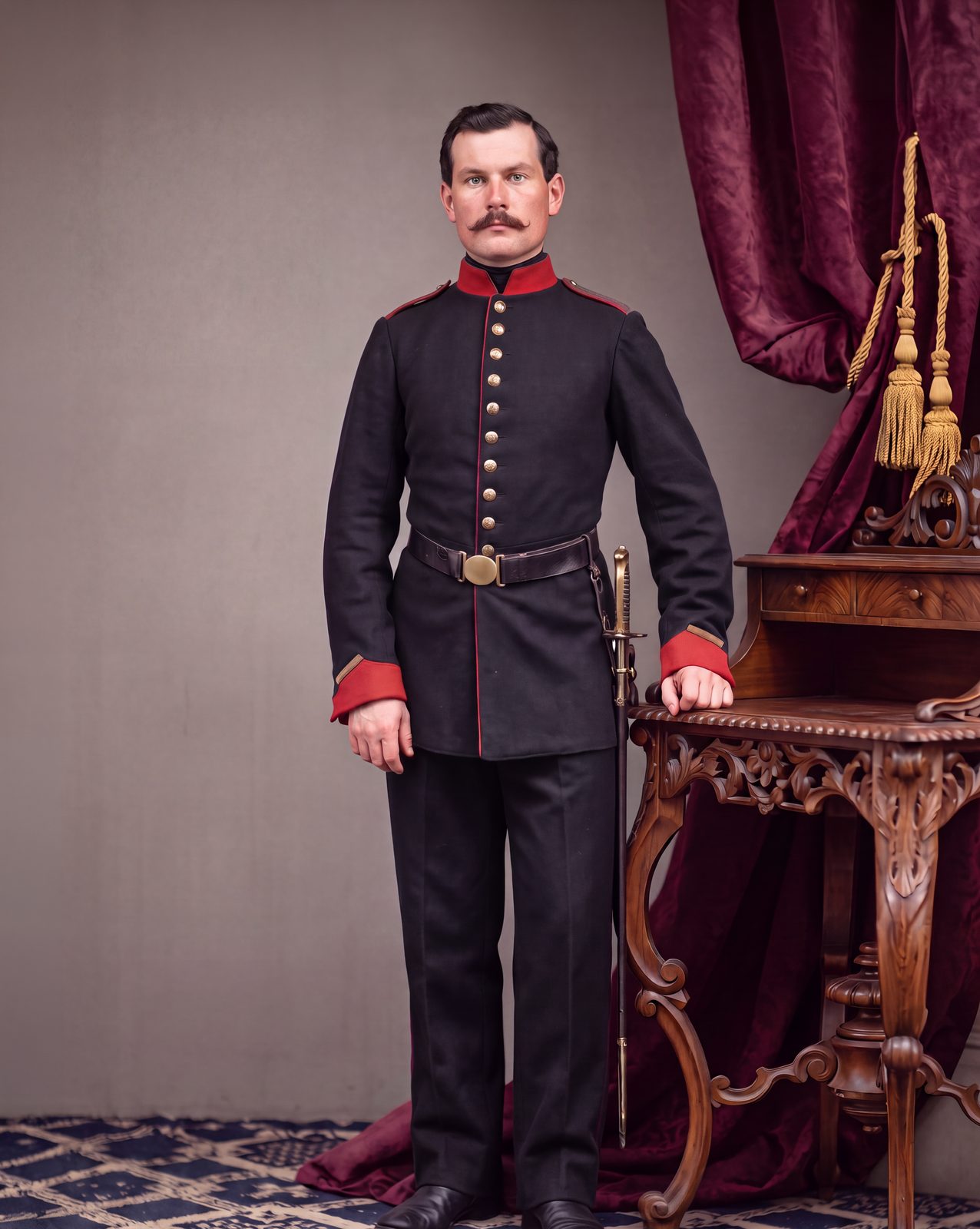
George kept his German military discharge among his emigration papers, and it survives in the family. It has not been fully transcribed, so whether it records completed service or a release from the obligation is not known; read alone, his release of 1859 and his chest ailment describe a man who did not serve. The family’s uniform portrait, which family tradition takes to be George (see George and Fredericka's Family, 1860 to 1907), shows a young man in uniform, with a stand collar, a single row of close-set buttons, plain cuffs, a belt with a plate buckle, and a sword, a cut that fits mid-nineteenth-century European infantry generally. No shoulder straps show on this reading, but the photograph’s transcript describes small shoulder straps and light-colored cuffs. Brunswick’s main army branches wore black by 1858 and 1859, but whether the uniform is Brunswick’s is not shown.
References
- Kemnade, Kirchenbücher (Taufen) 1815–1843, 1838–1842 and 1843–1868, Landeskirchliches Archiv der Evangelisch-lutherischen Landeskirche Hannovers, Kirchenkreis Holzminden-Bodenwerder, Archion online viewer. Read and transcribed 11–12 September 2026. Yielded the baptism of Georg Wilhelm Ehrenfried Wesemann (1838, Bild 5, Nr. 9), the two older siblings of 1833 and 1836, the Brand and Wesemann sponsors from Linse, and the 1863 pastoral correction signed by Berkenbusch. Also Kemnade Kirchenbuch 1843–1868 (churchRegister 390699): the births of 1843–1851 (Bild 4 to about 46); the burials of 1852–1868, form IV, Bild 195–224, with Bild 214 (1863 no. 3, written p. 480); the alphabetical register, Bild 223–242. Also Kemnade Kirchenbuch 1815–1843 (churchRegister 390697): the burials of 1834–1836 (Bild 150–151).
- NLA WO, 12 Neu, Nr. II E 15, Bd. 8 (1860), Wesemann, Georg Wilhelm Ehrenfried, Thran; emigration/passport index entry, fonds 39 S Slg, Auswanderer 18. und 19. Jahrhundert, Amt Eschershausen, Niedersächsisches Landesarchiv, Wolfenbüttel. The series runs to eighteen volumes: volumes 02 to 18 cover one year each and are indexed person by person; volume 01 covers 1833 to 1850 as a single undifferentiated unit with no person-level index. Also NLA WO, 12 Neu 2, Nr. II E 15/01, “Emigrations-Konsense, Entlassung aus d. braunschw. Untertanenverband: Einzelfälle,” 1833–1850 (Arcinsys, the fonds tree of 12 Neu; original only, no images); and the Amt Eschershausen section of NLA WO, 39 S Slg, read in full (671 entries).
- correspondence with Jürgen Diehl, Niedersächsisches Landesarchiv, including his answer on the 1850s muster rolls (NLA WO, 26 Neu 1, section 14). Read the record
- Halle Kirchenbuch “Taufen Beerdigungen 1800–1814” (04-03075, churchRegister 390649, 188 images) and “Trauungen 1800–1808” (04-03076, churchRegister 390650), Kirchenkreis Bodenwerder, Archion online viewer. Also: Trauungen, Jg. 1804, Nr. 3 (Brand–Sporleder); Begrabene, Jg. 1803, Nr. 36 (Bild 167, written p. 310, the Brünig child) and Jg. 1800, Nr. 24 (Johanne Marie Brand); Begrabene, Jg. 1804, Nr. 27 (Bild 170, the Mittelmüller infant); Taufen, Jg. 1805, Nr. 21, Jg. 1809, Nrs. 16 and 17 (Bild 96, written p. 187), Jg. 1810, Nr. 36 (Bild 110), Jg. 1812, Nr. 20 and Jg. 1813, Nr. 36. The volume has no surname index of its own; images 185 to 188 run to an Ende marker. Also Begrabene, Jg. 1805, Bild 172, Nr. 18 (the Leibzüchter Johann Heinrich Waßmann, 29 November 1805, aged 76). Also: Trauungen 1800–1808, Bilder 3–20 (every entry), Bild 14, p. 22, entry 1 (the 1803 marriage of Ludewig Wesemann and Justine Marie Küster) and Bild 18, p. 31, entry 5 (the 1807 marriage of Friedrich Wilhelm Brand and Caroline Louise Wesemann); Taufen, Bild 87 (1808), Bild 109, no. 33 (8 August 1810) and Bild 143, no. 31 (20 November 1813). Also: Trauungen 1800–1808 (390650), 1804 no. 3; Begrabene, Bild 167, 1803 no. 35 (Georg Ludwig Sporleder); Taufen, Bild 100 (1810 nos. 1 and 2) and Bild 129 (1812 no. 20); the baptisms of August 1809 – 1814 (about Bild 94–152).
- Linse Kirchenbuch 1815–1853 (signature 04-03142, churchRegister 390716) and Linse Kirchenbuch 1854–1875, Kirchenkreis Bodenwerder, Archion online viewer. Full variant-name sweep of images 2–90 of the earlier volume, producing 29 hits and the bound-in W surname index at image 89; high-resolution reading of the 1832 marriage and baptism, the 1855, 1858 and 1861 death entries, and the 1857 baptism, 30–31 August 2026. Transcriptions:); the 1832 infant death (Verstorbene, Jg. 1832, Nr. 2); the 1838 stillbirth (Geborene, Jg. 1838, Nr. 10 and the unnumbered row following, Bild 27, written pp. 46–47); the 1846 marriage (Proclamierte und Copulierte, Jg. 1846, Nr. 1, Bild 58, written p. 149); the 1847 deaths (Verstorbene, Jg. 1847, Nrs. 1, 3 and 4); the 1852 death of Hanne Caroline Wilhelmine Waßemann geborene Brand (Verstorbene, Jg. 1852, Nr. 1, Bild 81, written p. 194); the volume’s own alphabetical surname index at written p. c. 197, Bild 83, B section read in full; and, in the 1854–1875 volume, the 1855, 1858 and 1861 deaths (Bild 46, 47 and 48, written pp. 215, 217 and 219) and the 1858 Leßing marriage (Trauungen, Jg. 1858, Nr. 3, Bild 35). Also, in Linse 390716: Bild 6 (1817 no. 3, the godparents of Dorothea Louise Friederike Wesemann), Bild 9 (1820 no. 2), Bild 10 (1822 no. 1), Bild 30 (1841 no. 6, the godmother Amalie Lüders née Küster) and Bilder 48–57 (the marriages of 1815–1841). Also, in Linse 390716: Bild 4–11, written pp. 2–15 (the baptisms of 1815 – January 1823, with 1815 no. 4, 1816 no. 2, 1818 nos. 2 and 4, 1821 no. 2 and the margin note of 5 September 1852 beside it, Bild 10, p. 13, and 1822 no. 2); Bild 14–19 (the godparents of 1827–1832); Bild 30 (1841 no. 8); Bild 33–46 (the baptisms of 1843–1853), with Bild 38 (1847 no. 3), 40 (1848 no. 2), 42 (1850 no. 1) and 46 (1852 no. 5); Bild 50–62 (the marriages of 1824, 1836, 1838, 1843, 1851 and 1853); Bild 64 (1817 burials, no. 1, written p. 161); Bild 66 (1822 no. 3 and 1823 no. 2, written p. 164); Bild 76–81 (the burials of 1847–1852, with the 1852 death re-read on enlarged crops). In Linse 390717: Bild 36 (1859 baptisms, no. 1); Bild 46–57 (the burials of 1854–1875, with 1855 and 1856 no. 2, Bild 46–47); the volume’s W index. Also, in Linse 390716: Bild 69 (the burials of 1830, no. 1, written p. 171). In Linse 390717: the marriage section of 1854–1875, read entry by entry.
- Archion support, its reply to a report of the scan gap in the Linse church books: the confirmation section of the Linse church books is not in the scanned volumes.
- NLA WO, 40 Neu 4, Nr. 1527 (1884–1886), Testament des Halbmeiers Wilhelm Brandt aus Linse.
- NLA WO, 273 N, Nr. 33, and NLA WO, 34 Z, Nr. 110, the compiled Braunschweig emigration card indexes. Each is one compiled index holding many people, not a per-person item; every citation names the person as well as the identifier. Cited here for Ludewig Brand of Halle, Handlungsdiener, consent 4 September 1854 (273 N, Nr. 33; 34 Z, Nr. 110 Bd. 3, Nr. 212).
- “Auswanderer aus dem Landkreis Holzminden,” Online-Familiendatenbank, Verein für Computergenealogie (ofb.genealogy.net), free, covering Linse, Thran, Halle, Hehlen and Eschershausen. Cited here for Heinrich Brand of Bremke, b. 1817, day labourer, emigrated 1860. Also the surname lists D and B, read row by row, with the Rühle Dörries family reports (Johann Carl Anton Dörries, miller at Rühle in 1814, and his daughter Caroline Eleonore Henriette Dörries, 1814–1896, who died at Hoboken, New Jersey).
- Rühle Kirchenbuch 1815–1839 (churchRegister 390750) and Kirchenbuch 1840–1859 (churchRegister 390751), Landeskirchliches Archiv der Evangelisch-lutherischen Landeskirche Hannovers, Kirchenkreis Bodenwerder, Archion online viewer: 390750, Bild 128, p. 302, 1838 no. 9 (the marriage of Carl Conrad Anton Dörries and Justine Wilhelmine Friederike Brand); 390751, the burial of July 1840 and the remarriage of March 1841. Also 390751: Bild 143, p. 311 (the burials of 1840, no. 16), Bild 117, p. 239 (the marriages of 1841, no. 2), and Bild 84, p. 162 (the baptism of Carl Franz Dörries, 1854, no. 11).
- Halle Kirchenbuch 1815–1844 (churchRegister 390651) and Kirchenbuch 1869–1875 (churchRegister 390653), Kirchenkreis Bodenwerder, Archion online viewer: 390651, the births of 1843–1844 (Bild 78–86); 390653, Bild 19 (1873 no. 2) and the burials of 1869–1875 (Bild 50–63), with p. 647 (1873 no. 7). Also 390651: the marriages of 1830–1844 (section III, Bild 99–113) and the combined alphabetical register (Bild 150–156); 390653: the marriages of 1869–1875, every entry.
- Halle Kirchenbuch 1845–1868 (churchRegister 390652), Bild 96, the 1848 marriage naming Karoline Küster, wife of the Bodenwerder innkeeper Heinrich Christian Ludewig Lönig.), Bild 22 (1849 no. 21) and the burials of 1852 – early 1868 (Bild 131–148), with p. 353 (1863 no. 1). Also the marriage lists of 1845–1852 (Bild 93–101) and of 1853–1868, every entry; the volume’s layout, sections I (baptisms), III (marriages) and IV (burials), with no confirmation section.
- Wesemann_Comprehensive_History_v8, George’s American arrival, service, marriage, will, death, and [name withheld]’s 2016 research.
- Georg Wilhelm Ehrenfried Wesemann, military discharge or release document (Duchy of Brunswick), in the family’s emigration papers, family archive. Not transcribed in full.
- Photograph of an unidentified man in military uniform, family archive scan, with transcript description